
Quick answer: Discharge planners refer patients to the home care agency that responds fastest, confirms receipt, and closes the loop afterward, not necessarily the one with the best care. Win repeat referrals with a deliberate system: one intake path, a written response standard measured in minutes, automatic loop-closing, and a partner kit that makes your agency the easy choice.
The Referral Decision Isn’t About Care Quality

A discharge planner works through a list of agencies under real-time pressure, often with a patient leaving the hospital that same day. In that moment, they aren’t evaluating your care philosophy. They’re evaluating who answers first, who makes the process easiest, and who clearly has their operation together. Owners consistently find that the first agency to respond wins the business the overwhelming majority of the time.
Which means most agencies lose discharge planner referrals to process, not quality: a referral email that sits for hours, no confirmation it was even received, and nothing distinguishing one agency from the next five on the hospital’s list. Every one of those failures is fixable with a system you can build this week.
Start With the 4 pm Friday Test
Have a friend send a test referral to your agency at 4 pm on a Friday, through whichever channel a real discharge planner would use. Time two things: how long until any confirmation, and how long until a human response. Then ask the harder question: would the sender know it was received at all? Most owners are surprised by both answers, and every discharge planner in your market already knows them. Write yours down. That’s the starting line.
Discipline 1: One Intake Path, Guaranteed Response
If referrals can arrive by fax, email, phone, and text, and each lands with a different person, you have four chances to miss one, and a planner only needs to be missed once.
Discipline 2: Close the Loop, Every Time, Automatically
The most common complaint referral partners have about home care agencies is silence: they send a patient over and never hear what happened. Fix it with a loop-closing standard:
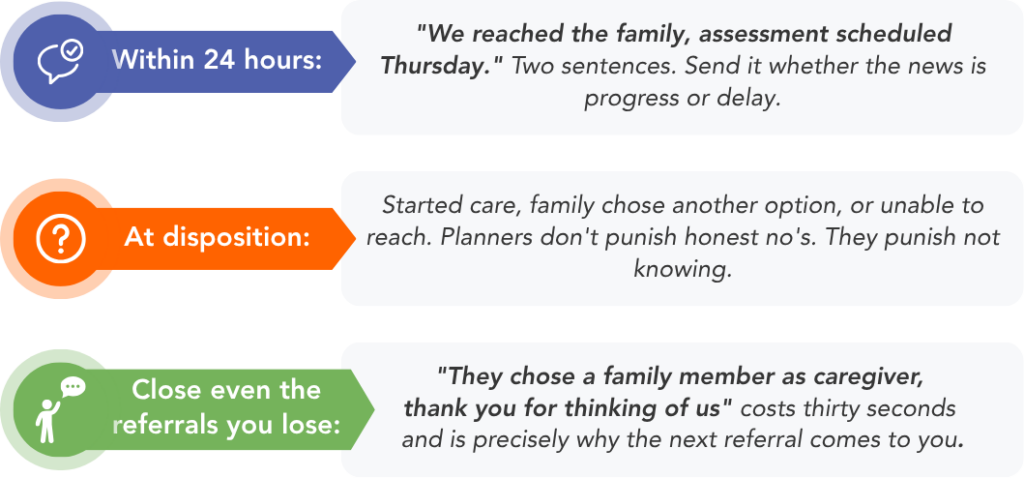
Keep a simple tracking sheet: referral date, source, response time, disposition, loop closed yes or no. Review it weekly. Response time and loop-close rate are the two numbers that predict whether a planner’s next patient comes to you.
Discipline 3: Build the Partner Kit
 A business card in a stack of a dozen looks like every other business card. Give planners something concrete to remember you by and something credible to hand a family in a hallway conversation:
Discipline 4: Protect the Team That Runs It
This system dies when the people responsible for the one-hour response are buried in routine phone traffic. Before promising planners speed, audit where your office hours actually go. Agencies that move caregiver and family communication onto automated systems consistently free up the equivalent of a part-time position, and that's exactly the capacity referral response requires. Growth systems fail on capacity before they fail on strategy.
What Agencies Report When They Run This System
Agencies that consolidate caregiver and family communication report cutting office calls by over 50% within the first two months, recovering the staff time that powers one-hour referral response. Tim and Kate Moynihan of Visiting Angels White Plains, NY measured 53% fewer office calls within 60 days of implementing structured communication protocols.
And on what happens when the referral process itself gets systematized, Christine Blum of Right at Home Nature Coast describes the operational mindset shift:
One agency owner recently described signing on as the preferred home care partner for a senior living community: the community wanted exactly this, a way to make a referral instantly and see who they're referring to, so their case managers could move on to the next patient. Two more communities asked for the same thing within a month. Speed and visibility aren't just how you win a planner's referral. They're becoming the price of admission to preferred partner relationships.
The Honest Part: What It Costs to Maintain
Run manually, for an agency with active referral relationships:
None of it is hard. All of it is relentless. The agencies that lose referral relationships rarely decide to stop responding fast. They just have a bad month, the loop-closing slips, a planner notices silence twice, and the referrals quietly reroute. Consistency is the entire product here, and consistency by hand is fragile.
How to Start This Week
1. Run the 4 pm Friday Test and write down both numbers.
2. Consolidate to one intake path with instant confirmation on it.
3. Write the response standard and build the on-call rotation to back it.
4. Start the tracking sheet and review response time and loop-close rate every Friday.
5. Build the partner kit starting with the payment options explainer, and deliver it to your top ten sources this month.
Frequently Asked Questions
Why do discharge planners choose one home care agency over another?
Primarily speed of response and clarity of process. Discharge planners work under time pressure and send patients to agencies that respond immediately, confirm receipt, and make the handoff easy to follow.
How fast should a home care agency respond to a referral?
Confirmation within minutes and a human phone call within one hour during business hours, with an on-call plan for evenings and weekends. Referrals that sit for hours are routinely lost to faster competitors.
How do you build relationships with hospital discharge planners?
Respond fast every time, close the loop on every referral including the ones you lose, and deliver one useful thing per month. Consistency over quarters, not lunches over weeks, is what earns preferred status.
What should a home care agency send referral partners?
A one-page service guide, a short owner welcome video, and a plain-language payment options explainer covering long-term care insurance, VA benefits, Medicaid, and private pay. The payment explainer removes the friction that most often stalls referrals.
If You'd Rather Not Maintain It by Hand
This system is what we've built and automated at enCappture as the Growth Hub, part of the CareCycle framework alongside the Caregiver Hub and Family Hub: a 24/7 referral form with instant three-way notification, automatic partner thank-yous and family welcomes, loop-closing updates, and the partner-facing resources, all inside your agency's own branded app. The consistency that's fragile by hand becomes the default.
Want to see where your referral response stands first? Take the CareCycle Self Assessment Ready to see it running? Book a quick strategy call with us.